Technical Parameter Comparison: Modern Controlled Fermentation vs. Traditional Pile Fermentation
From "Providence" to "Computing Power": A Paradigm Shift in Fermentation
In the circles of tea and tobacco processing, if you ask a master with thirty years of experience what fermentation is, he will likely squint his eyes, sniff the faint aged aroma in the air, and tell you: "Fermentation is a battle of wits with nature."
In that era where success was determined by "feel" and "nose," fermentation was a high-stakes gamble. We faced tens of tons of massive piles, lying in humid workshops like a sleeping giant, breathing, decomposing, and maturing. Today, when we walk into modern factories equipped with high-precision sensors, constant temperature and humidity chambers, and automated control systems, we find that the giant has been locked inside a meticulously designed "glass house."
This transformation from "guessing by experience" to "deciding by data" is not merely an equipment upgrade but a complete reconstruction of fermentation's underlying logic.
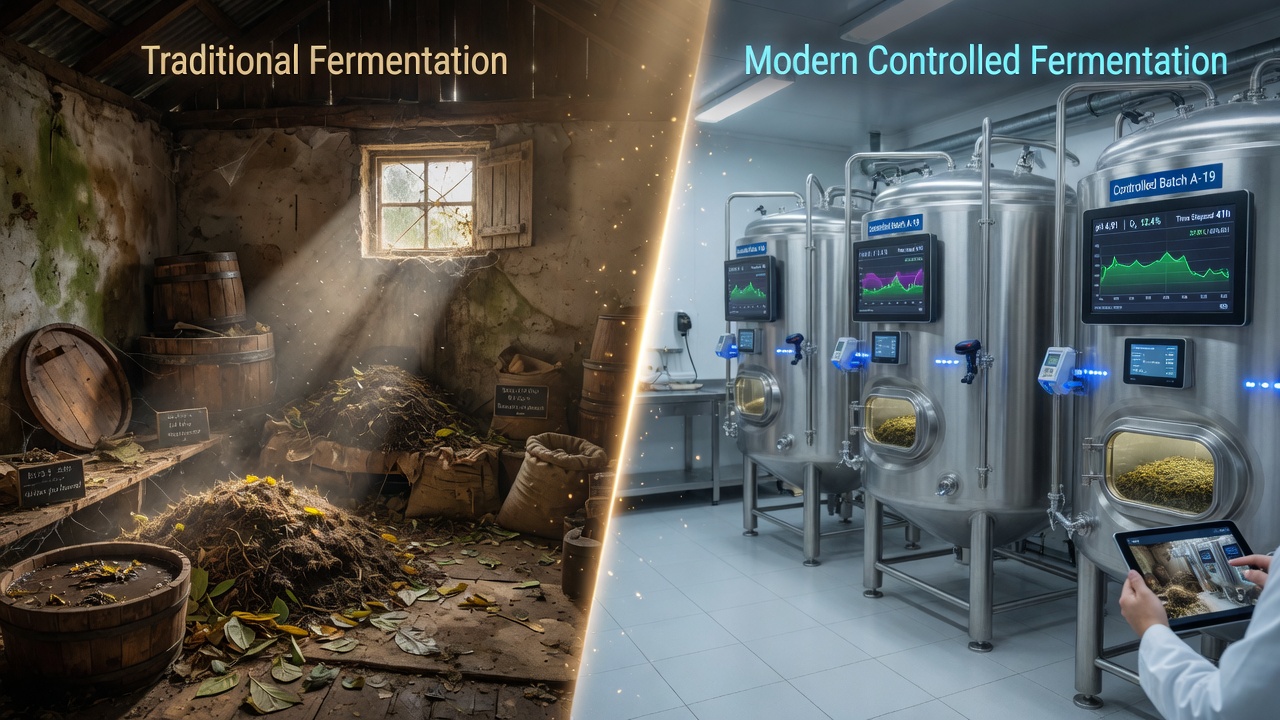
Traditional "Chaos Aesthetics": The Gamble of Large Pile Fermentation
Recalling the summer of 2005, I interned at a traditional processing facility in Menghai, Yunnan. Back then, we had no "temperature and humidity curves" — only "turnover count" and "pile temperature by hand feel."
Traditional pile fermentation (what we commonly call "wo dui" or wet piling) is a typical open, large-scale solid-state fermentation. Our operational logic was extremely crude: pile tens of tons of raw material into a small mountain, relying on natural environmental microbes for inoculation. At that time, water control was entirely "weather-dependent." If the rainy season struck and workshop humidity soared, planned water supplementation had to stop immediately; otherwise, the entire pile would easily undergo anaerobic fermentation due to excessive moisture, producing a nauseating sour odor.
In such large piles, temperature was extremely uneven. The center of the pile could reach 55°C or higher, while the edges might only be 30°C. This enormous temperature difference caused uneven fermentation — the central portion might undergo excessive degradation, even partial carbonization, while the edges remained in the early stages of microbial growth. I remember once, to rush an order, we performed high-intensity pile turning for three consecutive days, trying to make the heat distribution uniform through physical means. But due to improper operation, we disrupted the fragile micro-ecological balance inside the pile. The final batch had a very "chaotic" aroma — both burnt and carrying a lingering musty smell.
The charm of traditional fermentation lies in its "complexity." Since the microbial community is the result of natural succession, containing a large number of miscellaneous bacteria, yeasts, and fungi, this diversity produces extremely rich aroma layers — what is known as "traditional aged fragrance." But this beauty is built on extremely high failure risks: unstable quality, a cycle lasting up to two months, extremely high labor intensity, and unavoidable hygiene risks — all are swords of Damocles hanging over producers.
Modern "Precision Surgery": The Order of Controlled Fermentation
Fast forward to 2022, I participated in a modern pilot project based on microbial tea processing technology. This time, we no longer faced that "giant" but instead faced clean, sealed rotating fermentation tanks.
The core of modern controlled fermentation lies in "certainty."
In that laboratory-grade factory, every parameter was quantified to two decimal places. We no longer relied on natural inoculation but directly used screened, dominant bacterial strains with specific metabolic functions (such as a specific ratio of Aspergillus niger spore suspension). This targeted inoculation was like installing a "navigation system" for the fermentation process.
What impressed me most was the segmented control of temperature and humidity. In traditional wet piling, temperature and humidity fluctuated randomly; in modern tank fermentation, we set extremely precise stage-by-stage targets. For example, in the early stage of fermentation, we precisely maintained internal humidity at 27%-28% and controlled temperature at around 45°C to induce rapid microbial colonization. Entering the middle stage, we raised humidity to over 35% through an automatic water supplementation system, while using mechanical stirring to slowly push the temperature to a peak of 55°C, accelerating the degradation of proteins and polyphenols.
The direct result of this control is a qualitative leap in efficiency. Traditional fermentation might require 50 days, yet through this precise parameter combination, we completed the transformation process in just 18 days — a process that originally needed two months. More importantly, the aroma profile of each batch was nearly identical. This stability is a lifesaver for manufacturers pursuing high-end, premium production.
Traditional vs Modern Controlled Fermentation
| Parameter | Traditional | Modern Controlled |
|---|---|---|
| Temperature Control | Large difference (center 55°C/edge 30°C), uneven | Precise staged control (early 45°C→mid 55°C) |
| Humidity Control | Weather-dependent, natural fluctuation | Auto replenishment, precise 27%-35% |
| Cycle | ~50 days | Only 18 days |
| Quality Consistency | Large batch variation, unstable | Nearly identical between batches |
| Microbial Source | Mixed bacteria, yeast, fungi from nature | Targeted inoculation of dominant strains |
| Flavor Profile | Complex traditional aroma, high failure risk | Stable, controllable, reproducible |
| Risk | Uneven fermentation, local carbonization, mold | Controllable, very low risk |
Core Battle: How Temperature and Humidity Reshape Aroma and Combustion
Many people ask me: since modern technology is so good, why not completely replace traditional methods? The answer lies in the microscopic influence of temperature and humidity.
The "Alchemy" of Aroma
Temperature and humidity are not just the growth environment for microorganisms; they are essentially "accelerators" and "regulators" of chemical reactions.
First is temperature driving the Maillard Reaction. In environments above 50°C, reducing sugars and amino acids in the raw material begin intense chemical reactions, producing large amounts of furans and pyrazines. These are precisely the sources of the captivating baked aroma, nutty scent, and caramel fragrance we perceive. In traditional large piles, due to the high core temperature, this reaction tends to be too violent, easily causing the aroma to become "overdone" with burnt bitterness. Modern controlled fermentation, however, can precisely control the timing and intensity of temperature peaks, keeping the generation of these aromatic substances at a perfect equilibrium — with depth without being jarring.
Second is humidity regulating enzymatic reactions and aroma precursor release. Humidity determines water activity (aw), which is the lifeblood of enzyme activity. Moderate humidity promotes glycosidase activity, releasing aroma precursors (such as bound terpene alcohols) that are "locked" inside plant cells, transforming them into free, perceptible floral and fruity notes. If humidity is too low, reactant diffusion is hindered, and the aroma becomes thin; if too high, it induces unintended microbial metabolism, producing unpleasant sour or off-flavors.
The "Physics" of Combustion
Beyond how it smells, fermentation also determines how it "burns."
This is an often-overlooked point. The fermentation process is essentially the degradation of the organic structure of raw materials. Through precise temperature and humidity control, we can more thoroughly and uniformly degrade the macromolecular carbohydrates and proteins in the raw material.
In traditional fermentation, due to large temperature differences, the physical structure degradation of raw materials is uneven. This leads to certain areas burning slowly with excessive smoke due to insufficient degradation, while other areas burn too quickly with excessive ash due to over-degradation.
In modern controlled fermentation, thanks to the uniform penetration of moisture and temperature, the cellulose and lignin structures of the raw material are more consistently modified at the molecular level. This results in a more stable combustion rate and smoother smoke without abrupt irritation. This "combustion stability" is actually an important invisible indicator of fermentation process quality.
My View: Not Replacement, But Evolution
After experiencing the leap from "muddy yard" to "clean laboratory," I have gained a deeper understanding of the relationship between these two approaches.
I believe the future trend is definitely not to eliminate tradition with modern technology, but to "tame" tradition with modern technology.
The complex flavor of traditional fermentation with its "wildness" is a gift of microbial diversity succession, which current targeted inoculation technology still finds difficult to fully simulate. But the inefficiency and instability of traditional fermentation — the "weather-dependent" approach — are pain points that modern industrial civilization must address.
We are entering an era of "controlled tradition." Using modern sensors and automation equipment, we can preserve the excellent, regionally characteristic microbial succession paths of traditional fermentation, while minimizing the "accident" risks caused by environmental fluctuations through precise temperature and humidity regulation.
What we pursue is no longer the "perfect batch" produced by luck, but a "craftsmanship quality" that can be scientifically explained, industrially reproduced, and still retains its soul.